Zin Taylor (*1978 in Calgary, Canada; lives in Paris)
Zin Taylor develops a distinct visual language deeply rooted in drawing, unfolding between surface, line, and space. His works revolve around questions of perception, translation, and the transformation of images and objects, positioning him as an important voice within an expanded, installation based drawing practice in contemporary art.
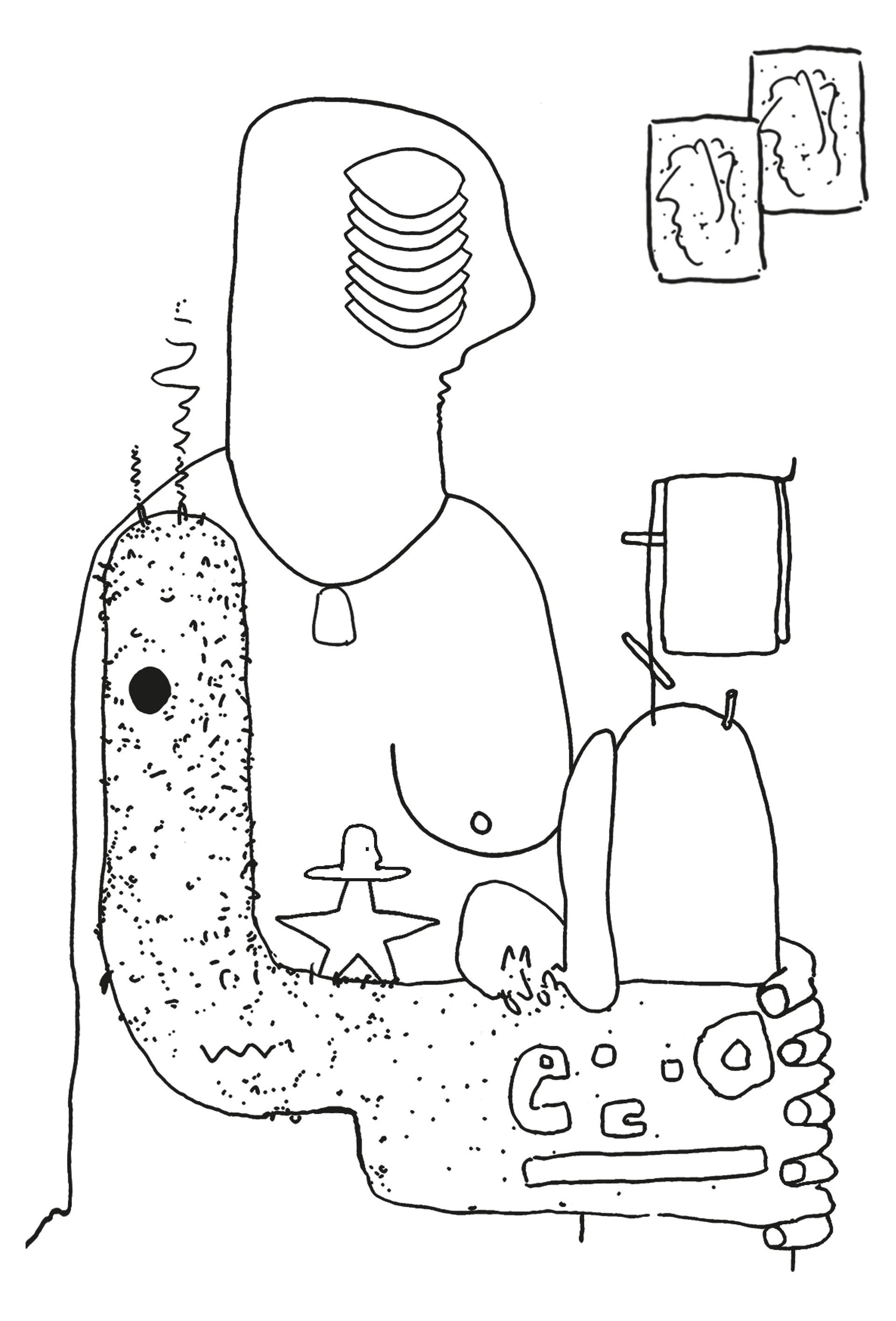
A defining feature of his work is his wall drawings, which are created directly on exhibition walls using clear, often black lines. They appear reduced yet precise, while at the same time often suggesting a subtle figuration. Within these linear structures, one can discern hinted bodies, everyday objects, or abstracted scenes. In this way, the works oscillate between abstraction and representation, opening up an imagined space that can be experienced both visually and associatively.
This graphic quality continues in his suspended, mobile like sculptures. Made from lightweight materials, they take up the linear structures of the wall works and translate them into space. The objects seem to float, respond subtly to air movements, and create a fragile, almost immaterial presence. A dialogue thus emerges between stillness and movement, between drawing and sculpture.
This interplay is further complemented by small scale objects presented in a large illuminated wall vitrine. In this concentrated setting, they appear like archived fragments or three dimensional sketches. The vitrine functions not only as a display format, but as an autonomous space of condensation. It frames the objects, isolates them from the surrounding space, and directs attention to their subtle differences and relationships.
Through the interaction of these groups of works, Taylor develops a multilayered structure in which line, object, and space continuously comment on one another. His works demonstrate how drawing can expand into space, while sculpture can simultaneously be traced back to its graphic origins.
FEATURED AT NEUN NEUE RÄUME